Profile. Compare. Act.

Java method profiling — inline in your IDE

See per-method execution time and call count in your editor. Compare sessions to track regressions. Export structured performance data for analysis.

Bytecode instrumentation · ~3% overhead · Runtime auto attach · JDK 8+

Works in IntelliJ IDEA Community & Ultimate, and VS Code

Profile → Compare → Act — all inside your IDE

How GalataJ Works

Three steps. One IDE. No context switching.

01

Profile

Inline method metrics in IDE

Inline Method Metrics

Execution time, call count, and memory allocation appear as CodeLens hints directly above your methods. No dashboards, no separate tools.

  • check_circle Real-time metrics updated as your app runs
  • check_circle Live profiling tab with sortable data
  • check_circle Context detection for HTTP, DB, and Scheduler calls
02

Compare

Session Comparison & Baseline Tracking

A single profiling snapshot doesn't tell you if things are getting better or worse. Save sessions, set baselines, and see exactly which methods regressed — and by how much.

  • check_circle Save and compare profiling sessions
  • check_circle Baseline tracking with regression detection
  • check_circle Session history for performance trends
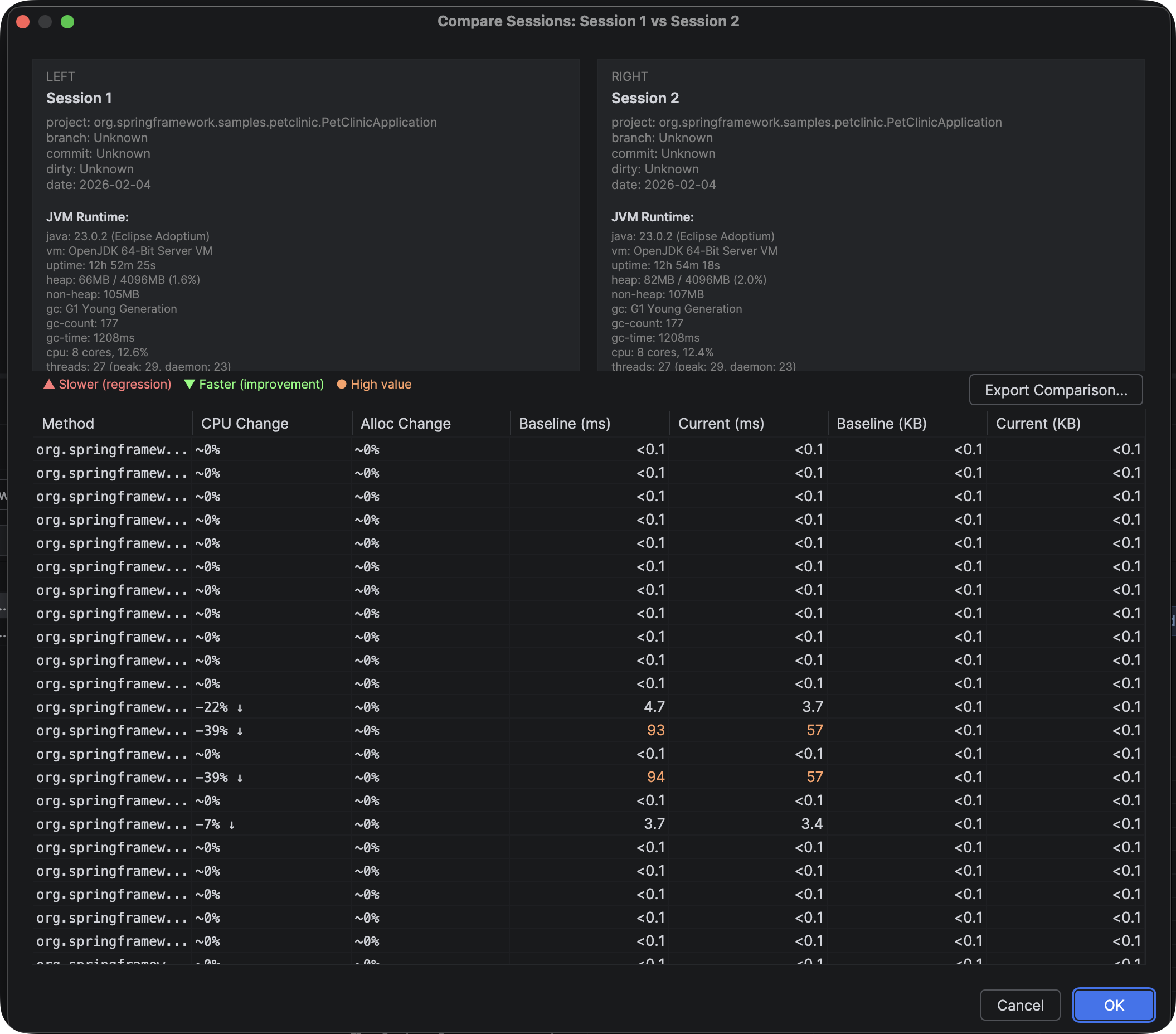
Session comparison and baseline tracking
03

Act

Structured Markdown context export

Structured Context Export

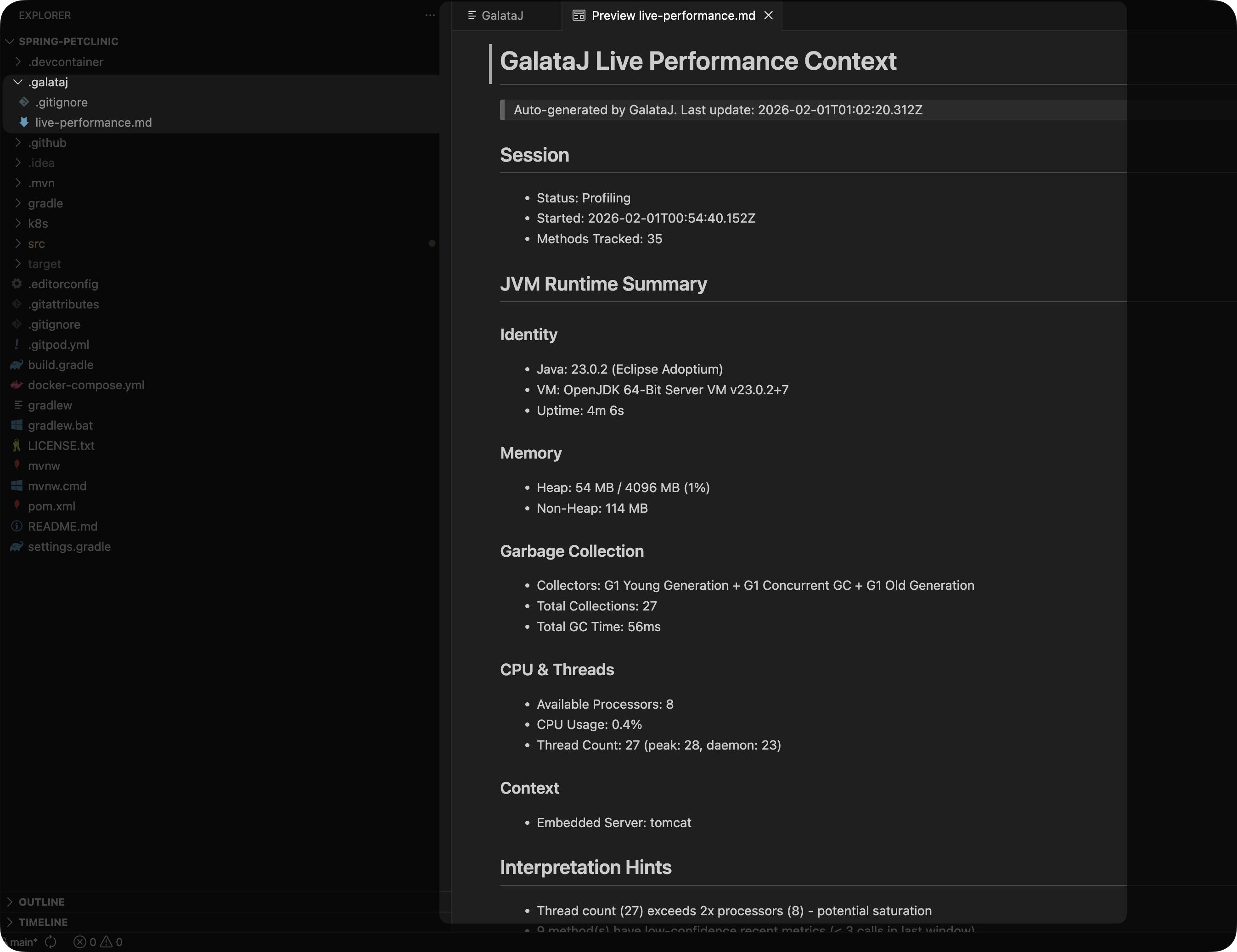
Profiling data exports as Markdown files in your project — .galataj/live-performance.md and .galataj/baseline-live-compare.md. Plain text, version-controllable, readable by you, your team, or your tools.

  • check_circle One-click "Add to Chat" for AI-assisted analysis
  • check_circle Export to JSON, CSV, and HTML
  • check_circle Custom prompts for repeatable analysis workflows

What GalataJ Doesn't Do

GalataJ is a developer profiler, not an APM or monitoring tool.
We help you find WHERE the problem is. Understanding WHY is your job.

close Not a replacement for Datadog, New Relic, or Dynatrace
close No automatic deadlock detection
close No SQL query content capture
close No distributed tracing
close No production monitoring alerts

Roadmap 2026

Upcoming features we're working on.

integration_instructions

CI Integration

GalataJ + CI — compare performance across git commits in your pipeline. Catch regressions before they merge.

2026
dns

Local MCP Server

AI tools talk with the profiler directly.

2026
smart_toy

Agent Skill

AI tools can call GalataJ CLI — run, perform, compare, act.

2026

UNDER THE HOOD

memory

Bytecode Instrumentation

Measures method execution time, memory allocation, and call frequency at the bytecode level. ~3% overhead.

bolt

Runtime Auto Attach

Attaches to any running JVM process automatically. No application restart, no JVM flags, no setup.

deployed_code

JDK 8+

Compatible with JDK 8, 11, 17, 21 and later. OpenJDK, Oracle JDK, Amazon Corretto. Windows, Linux, macOS.

Frequently Asked Questions

Common questions about functionality and compatibility.

What is the performance overhead?

GalataJ has approximately 3% overhead. It uses efficient bytecode instrumentation to measure method execution time, memory allocation, and call frequency. The agent only instruments methods you're actively profiling, minimizing impact. This overhead is acceptable for development and testing but we don't recommend it for production workloads.

Is it free? What's the difference between Free and Pro?

Yes, GalataJ has a generous Free tier! Free includes: inline metrics in your code, live profiling tab, context detection (HTTP, DB, Scheduler), and limited session saves. Pro unlocks: unlimited session saves, session comparison for regression detection, export to JSON/CSV/HTML, local Docker support, live context files for AI (.galataj/live-performance.md), and baseline tracking.

Do I need to restart my application?

No restart required! GalataJ uses runtime auto attach — it connects to any running JVM process without stopping your application. Just click 'Start Profiling' in your IDE, select your Java process, and metrics start appearing immediately.

What Java versions and IDEs are supported?

GalataJ requires JDK 8 or higher and is compatible with all modern Java runtimes including OpenJDK, Oracle JDK, and Amazon Corretto. It supports both IntelliJ IDEA (Community and Ultimate) and VS Code with full feature parity. Available on Windows, Linux, and macOS.

How does the structured context export work?

GalataJ generates structured Markdown files in your project's .galataj/ folder: live-performance.md (real-time hotspots and trends) and baseline-live-compare.md (regression detection against your baseline). These are plain text files — you can read them, diff them, use them in code reviews, or feed them to AI assistants like Cursor, ChatGPT, or Copilot for contextual performance analysis.

How does it differ from APM tools?

GalataJ is a developer profiler, not an APM. It shows you which methods need attention directly in your IDE during development. APM tools like Datadog, New Relic, and Dynatrace are for production monitoring, alerting, and distributed tracing. We're complementary: use GalataJ to find and fix performance issues during development, then deploy with confidence and monitor with APM.